Showing posts with label Ancient. Show all posts

Saturday, 25 October 2025

Rome: The Colosseum, Palantine Hill and Forum

My choice of big touristy thing for Rome was the Colosseum. I choose a time slot toward the end of the day, hoping for better light and fewer people. I certainly got the light and the crowd did lessen in the final hour. My ticket also gave me access to the Forum and Palantine Hill within 24 hours, so that was my first destination the next morning. I found an entrance on the Palantine Hill side, near the Circus Maximus. Most people seemed to enter on the Forum side, neat the Colosseum. This meant that my exploration of the Palatine Hill was quieter than expected. The top of the Palantine gave an excellent view of the city. 


Wednesday, 22 October 2025

Herculaneum

With no more than two nights in any city, I had to carefully choose what I wanted to see. This was especially true of the tourist hotspots. Whilst in Naples I had time to visit either Pompeii or Herculaneum, but not both. I asked a few colleagues who had visited both, which was their preference. The general consensus was Herculaneum.

Herculaneum was a smaller, more elite, town than Pompeii. The smaller size makes it easy to see the whole town in about half a day. The level or preservation is also different. Due to its location, Herculaneum was only mildly affected by the first phase of the eruption. While roofs in Pompeii collapsed under the weight of falling debris, only a few centimetres of ash fell on Herculaneum, causing little damage. Nevertheless, the ash prompted most inhabitants to flee. The first pyroclastic surge, flowed down the mountain and through the mostly-evacuated town at 160 km/h. Most of the victims of this surge were found on the beach and in the boathouses. A succession of six flows and surges buried the city's buildings to approximately 20 m, causing little damage in some areas and preserving structures, objects and victims almost intact. However, other areas were damaged significantly, knocking down walls, tearing away columns and other large objects. Unlike Pompeii, the mainly pyroclastic material that covered Herculaneum carbonized and preserved more wooden objects such as roofs, beds, and doors, as well as other organic-based materials such as food and papyrus. Frescos and mosaics are better preserved than Pompeii and some of the colours are stunning.


Wednesday, 28 September 2016

Orkney - Ring of Brodgar

I have saved the most iconic Orkney location until last.  The Ring of Brodgar is an almost 104 metre wide neolithic stone circle and henge.  It is originally thought to have contained 60 stones, but today only 27 remain.  During my stay on the Orkney mainland, half of the ring had been fenced off, to allow drainage improvements to the path.  Fortunately, the other half of the ring was clear of obstructions.  It was also a short drive from where I was staying, making it an ideal location to try for a sunrise.

Despite it being the last week in July, sunrise was still just before 5am,  with sunset just before 10pm.  On a couple of mornings during the week, I had looked out my bedroom window at 4.30am or so, to check out the prospects, and decided to go back to bed.  It wasn't until the last day that it was worth actually getting up and out.  I arrived at the ring just before the sun broke the horizon.  Once it did, the stones took on a beautiful golden glow.  This only lasted about half an hour.  After that the sun reached a bank of cloud and that was that.

I mentioned in an earlier post that, aside from the periodic coaches of day trippers, there weren't that many visitors to get in the way wherever I went.  But one thing that amazed me, given the photographic opportunities, was the complete absence of other serious 'togs.  I didn't see a single other tripod in 7 days.  You can visit the Castlerigg Stone Circle in the Lakes, for any given sunrise, and be certain to share your experience with a few other photographers.  At Brodgar there was not a soul around to trouble me.  In fact, it was so deserted that a small Imp of the Perverse in my head said I should 'do a Billy Connolly'.  But, dear reader, you will be pleased to know I resisted.  Besides, I wanted to shoot another location before breakfast.


Thursday, 8 September 2016

Orkney - Stenness

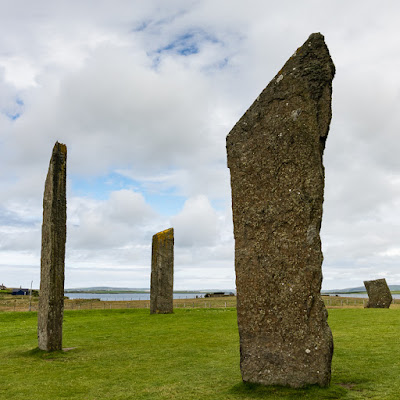
The standing stones of Stenness are possibly the earliest henge monument in the British Isles, dating from approximately 3100 – 2900 BC.  They are situated in an area rich with neolithic sites.  A second circle, the later and larger Ring of Brodgar, lies just over 1km to the northwest, on the other side of the lochs of Stenness and Harray.  There are also three other individual stones (the Comet Stone, the Watch Stone and Barnhouse Stone), the burial chamber of Maeshowe and an ongoing major archaeological dig at the Ness of Brodgar, all within walking distance.  Orkney wears its ancient history like few other places in the world.  Egypt is only other place I have visited where venerable monuments seem to casually litter the side of the road.

Although Stenness is a smaller circle than that at Brodgar, the stones themselves are much bigger, with a maximum height of six metres.  Four stones remain, from an original 10 or 12  that were laid out in an ellipse.  At the centre of the ring is a large stone hearth, similar to those found in Skara Brae and other Neolithic settlements.

A quick note on photography in Orkney.  First off, the weather.  Weather forecasts can only be trusted for the following hour, after that they become increasing random guesses.  With no hills, few trees and no major land masses to the west until you reach Newfoundland, weather fronts seem to whip through the isles.  Yes, of course it’s going to rain!  It’s the far north of Scotland, what did you expect?  But in Orkney, more so than anywhere else I’ve been in the UK, the old joke applies that, ‘if you don’t like the weather, just wait 10 minutes’.  Secondly, people.  The other touristy types who like to stand in front of you just as you're trying to take a shot.  Given the location, it should probably not be surprising that the many attractions Orkney has to offer aren’t constantly thronged by visitors.  What there are, however, are coachloads of day-trippers, intent on seeing all that Orkney has to offer in a single hit.  It can be rather disheartening to turn up somewhere at the exact time as a couple of 57-seaters.  All you can do is wait them out.  Fortunately their itineraries preclude them from staying at one location for too long (“and we’re walking, we’re walking”).  Just watch out for the next coach.


A short walk past the stones, on the shores of Loch Harray, is the remains of the neolithic Barnhouse Settlement. Only the partially reconstructed foundations of the buildings remain.  These are thought to date from between 3300 and 2600 BC.  A total of 15 buildings were unearthed during an archaeological dig in the 1980's.  The houses were similar in construction to those at Skara Brae, but were free standing rather than built into the earth and a midden pile.  From their layouts, two of the buildings, 'Structure 2' and 'Structure 8', are thought to have been used for ceremonial purposes, rather than as dwellings.  It is also thought that 'Structure 8', which is aligned with the Barnhouse Stone and Maeshowe, was built after the rest of the village had been abandoned and purposefully destroyed.