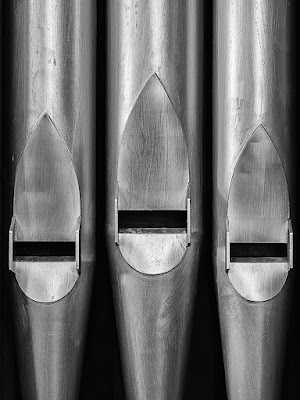
A few weeks ago, I joined other CCC members for a morning at Madingley Hall. We have met up there a few times in the past and on this visit I wanted to concentrate on the little parish church. I spent quite a time inside, doing wide interiors and detail shots. It wasn't the sunniest of days, but the occasional shaft of light gave a little more interest.
Showing posts with label Church. Show all posts
Friday, 29 March 2024
Church of St Mary Magdalene, Madingley
Friday, 11 February 2022
Church of St Mary Magdalene, Madingley
I recently joined other club members for a meet-up at Madingly Hall. As well as getting to chat to people in real life that I now typically see on screen, I was also keen to photograph a few things I missed last time. In particular, the interior of the parish church. It's a lovely space, and I spent a pleasant hour playing about with viewpoints.
Friday, 16 July 2021
Churchyard Infrared
It's been a while since I last used the IR camera. So, I thought I would try a few shots in the churchyard of St Mary's in Eaton Socon. To encourage wildlife, the grass around the graves had been left long, which made a soft counterpoint to the stones. The early evening light also helped with some shadows.
Saturday, 29 February 2020
Snowdrops at Benington
These images were all taken early in the month, before all the recent storms started. It's been a few years since I last took a trip to Benington, so I thought it was time for a revisit. The gardens of Benington Lordship are great, but this trip, like many in the past, I didn't get that far. Instead I spent my time in the churchyard of the church of St Peter. This too has a superb display of snowdrops, with the added attraction of the old gravestones.


Wednesday, 14 September 2016
Orkney - St Magnus Cathedral
St Magnus Cathedral, in Kirkwall, is known as the 'Light in the North' and is the most northerly cathedral in the British Isles. It was founded in 1137 by the Viking, Earl Rognvald, in honour of his uncle St Magnus. The building uses a combination of red and yellow sandstone, often in alternating courses or a chequerboard pattern. Due to its age, the windows of St Magnus are much smaller than found in most later churches.
The cathedral is free to visit. I went on a rainy morning, but even so there weren't that many visitors. I don't think it's a stop for the coach tours. The staff were lovely. A quick word and they gave me permission to shoot with a tripod (no specific permit required). One of them later told me the story of a time when a chap walked in and asked to shoot with a large format camera. Permission given, he set to work. Then another dozen other 'togs walked in, all of them also sporting large format cameras. They, apparently, were a club on an outing. But the first chap had nothing to do with them. He just happened to be out on the same day. He probably thought he'd get the place all to himself. Bet he was annoyed.
Monday, 29 August 2016
Orkney - The Italian Chapel
The Italian Chapel is a highly ornate Catholic chapel on the island of Lamb Holm. It was built during World War II by Italian prisoners. They were held in Camp 60, on the the previously uninhabited island, while they constructed the Churchill Barriers. It was built from two Nissen huts, joined end-to-end and utilised the limited materials available to the prisoners. The corrugated interior of the huts was covered with plaster and painted to resemble brick and carved stone. The altar, altar rail and font were constructed from concrete, left over from work on the barriers. A concrete façade conceals the front of the hut, making the building look like a stone built church.
Most of the interior decoration, including all of the the sanctuary end of the chapel, was done by a prisoner named Domenico Chiocchetti. Like the Churchill barriers themselves, the chapel was not completed until the end of the war. Chiocchetti stayed on for a while, after his fellow prisoners were released, in order to complete his work. The chapel is the only remaining building of Camp 60. Since the end of the war it has been restored twice. Once in the 1960s, when Chiocchetti returned to help with the work, and again in the 1990s.
Subscribe to:
Posts (Atom)